
Voice AI Has Entered a New Era. Here's What Businesses Should Prepare For
The conversational AI industry has reached an important milestone. Recent developments including the launch of xAI's Grok Voice Agent Builder demonstrate that building AI-powered voice agents is becoming significantly more accessible. Capabilities that once required specialized engineering teams, complex integrations, and months of development are increasingly available through no-code or low-code platforms.
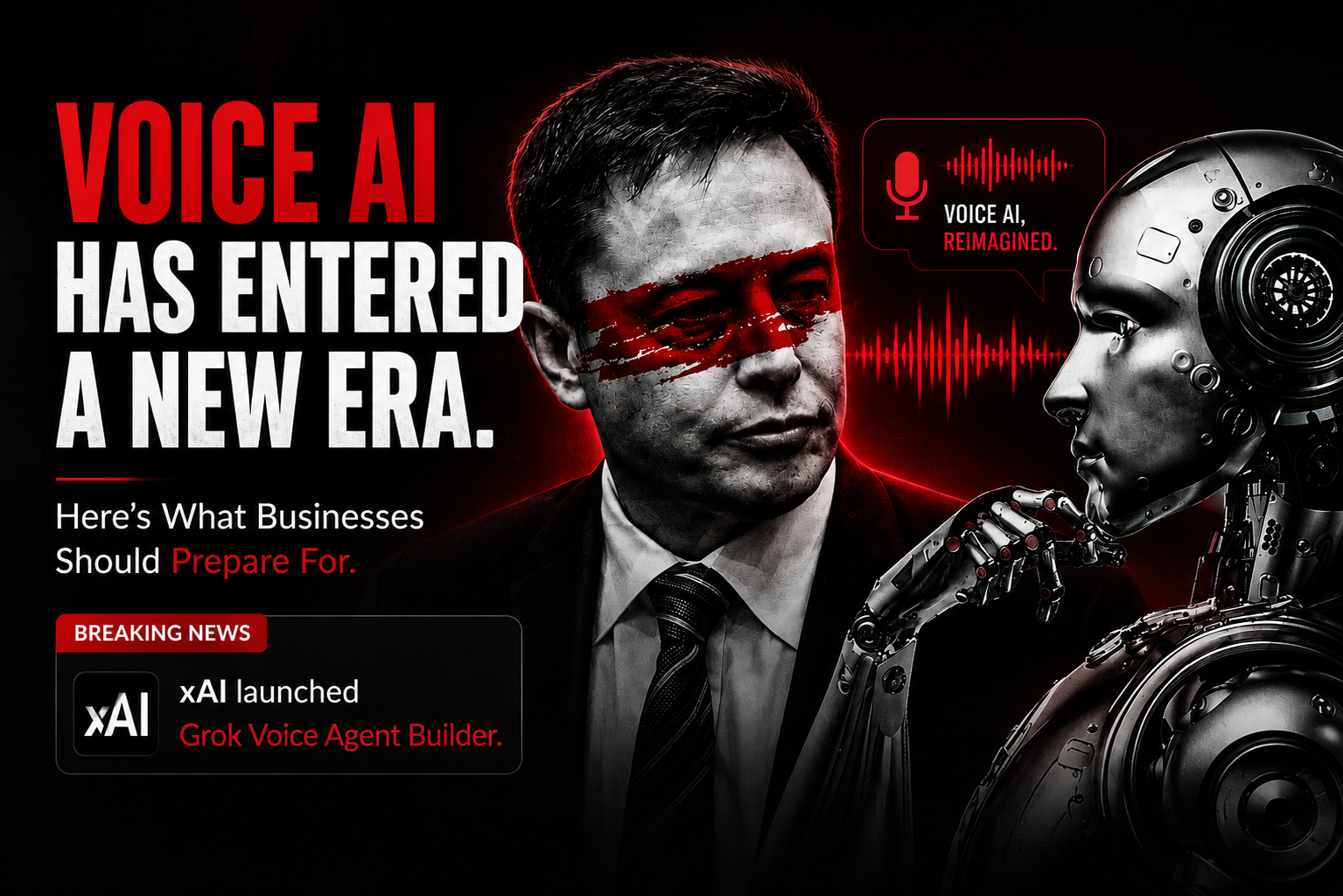
The conversational AI industry has reached an important milestone.
Recent developments including the launch of xAI's Grok Voice Agent Builder demonstrate that building AI-powered voice agents is becoming significantly more accessible. Capabilities that once required specialized engineering teams, complex integrations, and months of development are increasingly available through no-code or low-code platforms. For the AI industry, this is an exciting moment. For businesses, however, it raises a much more important question.
If everyone can build a voice agent, what will actually differentiate businesses in the years ahead?
Voice AI Is No Longer Experimental
Not long ago, Voice AI was viewed as an emerging technology. Today, it has become an active investment area for startups, cloud providers, telecommunications companies, and global AI organizations.
- Natural conversations.
- Low-latency responses.
- Multilingual support.
- Speech synthesis.
These capabilities are rapidly becoming industry expectations rather than competitive advantages. This shift mirrors what happened with websites, cloud infrastructure, and CRM platforms.
Eventually, the technology itself became accessible to everyone.
The competitive advantage shifted from owning the technology to how effectively businesses used it.
Voice AI is entering the same phase.
The Market Is Moving Beyond Conversations
Many organizations still evaluate Voice AI by asking questions such as:
- How natural does it sound?
- How quickly does it respond?
- Which language models does it use?
While these remain important technical considerations, they are becoming increasingly difficult to use as long-term differentiators.
Customers rarely remember which speech synthesis engine powered their interaction.
They remember whether their problem was solved.
Businesses should therefore begin asking a different set of questions.
- Can the AI understand business context?
- Can it remember previous customer interactions?
- Can it qualify opportunities without losing accuracy?
- Can it execute business workflows instead of simply answering questions?
- Can it contribute measurable business outcomes?
These questions define the next generation of conversational AI.
The Evolution From Voice Agents to AI Employees
The industry has largely focused on building systems capable of conversation.
The next phase requires systems capable of responsibility.
There is a meaningful distinction between the two.
A voice agent is designed to communicate.
An AI Employee is designed to own a business function.
That distinction changes how organizations think about deployment.
Instead of asking an AI to answer calls, businesses begin asking it to manage appointment scheduling.
Instead of responding to customer enquiries, it qualifies leads, updates the CRM, remembers previous conversations, and hands over complete context when human intervention is required.
The conversation becomes only one part of a larger operational workflow.
Execution becomes the real objective.
Why Memory Will Become a Competitive Advantage
One of the largest gaps in today's conversational AI landscape is continuity.
Many systems treat every interaction as an entirely new conversation.
Human relationships do not work that way.
Customers expect businesses to remember who they are, what they previously discussed, and where their journey currently stands.
Persistent conversational memory transforms AI from an answering system into a relationship system.
This capability becomes increasingly important as businesses scale customer interactions across multiple channels and departments.
The future of customer experience will depend as much on contextual understanding as conversational ability.
The Future Will Be Defined by Business Outcomes
The emergence of voice agent builders represents an important step forward for the industry.
It lowers barriers to innovation and accelerates adoption.
However, widespread accessibility also changes the nature of competition.
Businesses will not differentiate themselves simply because they have implemented Voice AI.
They will differentiate themselves by how intelligently that AI contributes to customer engagement, operational efficiency, and business growth.
The conversation is no longer about whether AI can speak.
It is about whether AI can meaningfully participate in the way businesses operate.
Looking Ahead
The latest advancements in Voice AI indicate that conversational technology is entering a new stage of maturity.
As adoption accelerates, organizations should shift their focus beyond deployment and toward capability.
The most valuable AI systems will not necessarily be those with the most realistic voices.
They will be the ones that understand context, retain knowledge, execute workflows, and consistently help businesses deliver better customer experiences.
At Zencia, we believe this is the natural evolution of conversational AI.
The future belongs not simply to voice agents, but to AI Employees intelligent systems that communicate, remember, and execute as trusted extensions of modern businesses.