
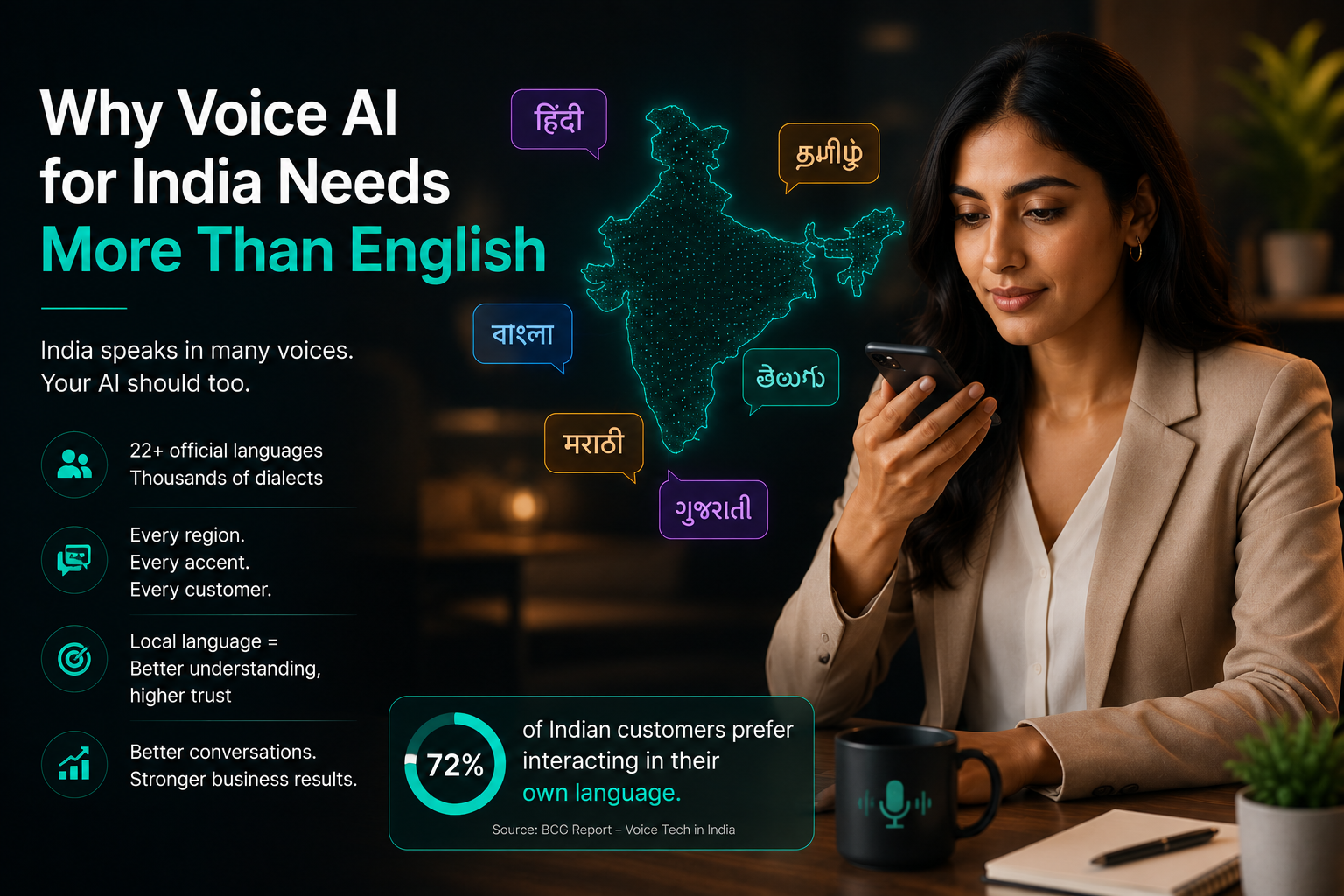
Why Voice AI for India Needs More Than English
English-only voice AI fails in India. So does Hindi-only. India has 22 official languages, hundreds of dialects, and 57% of urban business conversations mix Hindi and English in the same sentence. Here's what building voice AI for India actually requires.
The Problem With "English-First" AI
A voice AI product launches in the US. It works brilliantly.
98% accuracy in English. Sub-second response times. Natural conversation flow. Impressive demo videos. Glowing reviews.
The company decides to expand to India.
They flip a switch. Enable "Hindi support." Launch in Delhi.
And immediately, things start breaking.
Customers speak. The AI mishears. It responds in stilted, formal Hindi that sounds nothing like how people actually talk. Someone code-switches to Hinglish mid-sentence "Bhai, yeh product ka price kya hai?" and the system breaks entirely.
In Lucknow, the accent is different from Delhi. In Chennai, customers switch between Tamil and English in the same sentence. In Ahmedabad, Gujarati speakers use an entirely different sentence structure. In Mumbai, everyone speaks a unique blend of Marathi, Hindi, and English that no training dataset ever captured properly.
The "Hindi support" that worked in the lab fails in the field.
This is not a hypothetical scenario.
A landmark national benchmark called Voice of India evaluating leading speech recognition systems across 15 Indian languages and 35,000+ speakers found a critical performance crisis for global AI models in the Indian market. Global tech players including OpenAI and Microsoft struggle to accurately recognise how Indians actually speak.
This is the core challenge that every voice AI company entering India faces and that most get wrong.
India Is Not One Language Market. It Is Dozens.
To understand why voice AI for India is fundamentally different from voice AI for the US or Europe, you have to start with the numbers.
India has 22 constitutionally recognised languages, hundreds of distinct dialects, and a population of 1.4 billion people speaking different languages.
But the raw number of languages is only the beginning of the complexity.
Hindi alone is not one language.
Global speech systems often treat "Hindi" as a single, standardised language. In reality, Hindi encompasses major dialects such as Bhojpuri and Chhattisgarhi each spoken by tens of millions of people. Bhojpuri alone has over 50 million speakers a population larger than most European countries. Yet these dialects remain among the most challenging for AI systems, with error rates jumping to 20–30% compared to the sub-10% seen in standard Hindi.
So when a global AI company says "we support Hindi" they almost certainly mean they support textbook, standardised Hindi. The kind spoken in news broadcasts and formal settings.
Not the Hindi spoken in homes, markets, and businesses across UP, Bihar, Rajasthan, and MP.
And Hindi is just one language.
Tamil spoken in Chennai sounds different from Tamil spoken in Madurai. Telugu in Hyderabad differs from Telugu in Vijayawada. Bengali in Kolkata is not Bengali in Dhaka. Every major Indian language has regional variations that matter enormously in real conversation and that most AI systems have never been trained on.
The Hinglish Problem Nobody Talks About
Walk into any urban Indian business. Listen to how people actually communicate.
They don't speak pure Hindi. They don't speak pure English.
They speak Hinglish.
57% of urban Indian business conversations mix Hindi and English within the same sentence, requiring specialised STT/LLM/TTS architectures.
A customer might say: "Mere liye ek appointment book kar do, aaj 3 baje ke baad koi bhi slot chalega, but make sure the doctor is available."
That sentence contains four language switches. Hindi, English, and back seamlessly, naturally, unconsciously.
For a human, this is completely normal. For a voice AI system trained on either English or Hindi in isolation, this sentence is a nightmare.
The AI has to:
- Recognise that the speaker is switching between languages
- Maintain context across the language switches
- Understand the full intent of the combined sentence
- Respond in a way that matches the speaker's own code-switching pattern
This is not a translation problem. Translation assumes a sentence is in one language.
This is a code-switching problem and it requires fundamentally different AI architecture to solve.
Most global voice AI platforms cannot handle it. They either force users to speak in one language or produce broken, unnatural responses when the conversation mixes languages.
The Accent Problem
Even within a single language, India's accent diversity is extraordinary.
Hindi spoken by someone from Lucknow has different vowel sounds, rhythm, and intonation compared to Hindi spoken by someone from Delhi, Jaipur, Bhopal, or Patna.
Tamil spoken in Coimbatore sounds different from Chennai Tamil. Gujarati in Surat differs from Ahmedabad. Marathi in Pune differs from Mumbai.
These are not minor variations. Even the best global models see a sharp decline in performance with regional Indian accents, with error rates jumping to 20–30% compared to the sub-10% seen in standard speech.
For a voice AI handling customer calls, a 20–30% error rate is catastrophic. That's one in every three to five sentences being misunderstood.
In a real business conversation where a customer is trying to book an appointment, ask about a property, or get a support query resolved that error rate means the conversation breaks down. The customer repeats themselves. Frustration builds. Trust evaporates.
And they call your competitor instead.
The Connectivity Reality in Tier 2 and Tier 3 India
The language challenge is compounded by a connectivity challenge that most AI companies building for urban, metro audiences never encounter.
Tier 2 and Tier 3 infrastructure 2G/3G connectivity, ambient noise, and non-standard pronunciations degrades AI performance by 25–40% compared to metro deployments.
A voice AI that works flawlessly in a Bangalore office on a high-speed connection may completely fail when:
- A farmer in Vidarbha calls from a 3G connection with poor signal
- A shopkeeper in Surat is standing in a noisy market
- A homebuyer in Kanpur is calling from a moving vehicle
Background noise, call quality degradation, and connectivity drops are not edge cases in India. They are everyday reality for hundreds of millions of potential customers.
Voice AI built for India must be robust to these conditions not just tested in ideal lab environments.
Why Translation Is Not Enough
When most companies think about "supporting multiple languages," they think about translation.
Translate the script into Hindi. Translate it into Tamil. Deploy.
This approach fails for three reasons.
1. Translation loses cultural context.
Language carries culture. The way you address someone, the level of formality you use, the expressions you reach for these are all deeply cultural, not just linguistic.
In Hindi, addressing someone as "aap" versus "tum" versus "tu" signals completely different levels of respect and familiarity. Getting this wrong in a business conversation doesn't just sound unnatural it can be perceived as rude or dismissive.
A translation engine doesn't know which form of address to use. A culturally-trained voice AI does.
2. Tone and pace vary by language.
Tamil speakers communicate with different rhythmic patterns than Hindi speakers. Gujarati business conversations have different norms around directness than Bengali conversations.
A voice AI that speaks Tamil with Hindi rhythm, or Gujarati with English pacing, sounds robotic and unnatural even if every word is technically correct.
3. Real conversations are never pure.
As we've seen real Indian conversations mix languages, mix registers, and mix formality levels constantly. Translation-based approaches assume clean, single-language input. Real Indian customers don't provide that.
For a voice AI system operating in Indian customer support, the task is not simply to pronounce words correctly in one language. It has to do so fluently across Hindi, Tamil, Malayalam, Kannada, Telugu, Marathi, Bangla, and English often within the same call, as agents and customers code-switch between languages mid-conversation.
What "Real" Multilingual Voice AI Looks Like
Building voice AI that actually works in India not just passes a lab test requires solving problems at every layer of the system.
Speech Recognition (STT) must:
- Be trained on real Indian speech not just standardised language samples
- Handle regional accents and dialects within each language
- Recognise code-switching between languages mid-sentence
- Perform reliably under poor audio quality and background noise
- Cover not just major languages but regional dialects
Language Understanding (LLM) must:
- Understand intent expressed across multiple languages in a single utterance
- Apply cultural context to interpret meaning accurately
- Handle the full range of Indian conversational patterns not just formal language
Voice Generation (TTS) must:
- Sound natural in each language not like a translated script read aloud
- Match the rhythm, intonation, and pace of native speakers
- Adjust formality and tone based on the customer's own communication style
The overall system must:
- Switch languages smoothly mid-conversation without breaking flow
- Maintain context and memory across language switches
- Perform under real-world Indian connectivity conditions
This is not a simple integration project. It is a fundamental engineering challenge that requires deep expertise in Indian linguistics, culture, and real-world deployment conditions.
The Opportunity This Creates
The difficulty of building voice AI for India is not a reason to avoid the market. It is precisely the reason why getting it right creates an enormous competitive advantage.
India's digital economy is growing at extraordinary speed. Voice is increasingly the preferred interface particularly in Tier 2 and Tier 3 markets where typing in English on a smartphone is a barrier, but speaking in one's native language is completely natural.
2026 is positioned as a critical year for regional language voice assistant innovation and deployment in India.
The businesses and the AI platforms that solve the Indian language problem correctly will serve a market of over a billion people that global platforms are currently failing.
That is not a niche opportunity. That is one of the largest untapped markets in the world.
How Zencia Approaches Indian Language Voice AI
At Zencia, we've spent two years building and deploying voice AI specifically for Indian businesses not adapting a global product for India, but building with India's linguistic reality as the starting point.
Our AI employees support 10+ Indian languages including Hindi, Tamil, Telugu, Kannada, Gujarati, Marathi, Bengali, Malayalam, Punjabi, and Rajasthani with awareness of regional accents and dialects within each.
They handle Hinglish naturally because that's how Indian business conversations actually happen.
They adjust their tone and formality based on how the customer speaks because trust in India is built through communication that feels culturally appropriate, not just technically correct.
And they work under real Indian conditions variable connectivity, ambient noise, and the full spectrum of how 1.4 billion people actually talk.
Building voice AI for India is hard.
That's exactly why we built it.
The Bottom Line
English-only voice AI is not voice AI for India.
Hindi-only voice AI is not voice AI for India.
Voice AI for India must speak the language of every customer in their dialect, at their pace, in the cultural register that builds trust and handle the natural code-switching that defines how Indians actually communicate.
The companies that understand this will build voice products that genuinely serve India's market.
The ones that don't will keep wondering why their AI works in the demo and fails in the field.
Zencia's AI employees speak 10+ Indian languages naturally, culturally, and in real conversation.
👉 Hear them in action at zencia.ai
Sources: Voice of India Benchmark Josh Talks & AI4Bharat (February 2026) · Business Standard · Tata Communications Voice AI Benchmark (April 2026) · Auto Interview AI Vernacular Guide 2026 · Vegavid Regional Language AI Report